Welcome: Suzhou Tsingcarbo Nanomaterials Co., Ltd



sale@tsingcarbo.com
+86 13646226232

Home Applications Light Absorbing Film for Camera Housings…
Why ADAS Front Cameras Need Inner-Wall Light Absorption
As advanced driver-assistance systems (ADAS) become standard, the front-view camera — the core of forward visual perception — is extremely sensitive to stray light. If the inner wall of the decorative housing (bezel) is highly reflective, ambient light bounces and scatters inside the housing, entering the lens as ghosts and haze that degrade image contrast and signal-to-noise ratio (SNR), hurting lane detection and object recognition. Inner-wall light absorption (matting) is therefore a standard requirement.
The Flaw of Traditional Flocking: It Sheds Fibers
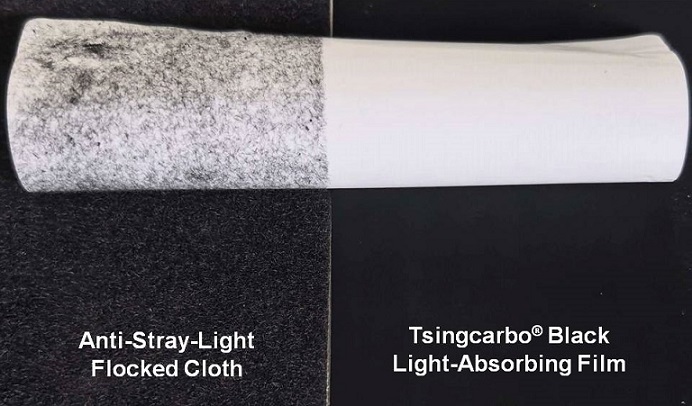
Many models use flocking — short fibers glued onto a substrate to form a velvety matte surface for light absorption. But the fibers are held only by adhesive; under prolonged vehicle vibration and thermal cycling they loosen and shed. Shed fibers that land on the lens make the vision system flag "lens dirty / obstructed," triggering a "clean front camera" prompt or a self-cleaning cycle.
This is exactly the widely reported complaint among EV owners (including public feedback on Tesla and similar models): the housing sheds fibers → false lens alert → repeated clean prompts. It annoys drivers and erodes trust in the assistance system.
The Solution: Tsingcarbo® Black Light Absorbing Film
Suzhou Tsingcarbo Nano Material's Tsingcarbo® Black Light Absorbing Film (model TCB-F-040) replaces the fiber structure with a continuous porous-carbon absorbing layer — eliminating shedding by design:
· Physically non-shedding: a continuous carbon layer with no loose fibers; it will not shed or contaminate the lens under vibration or thermal cycling.
· Excellent absorption: ~1% full-hemispherical reflectance across 200–2500nm; equal to or better than flocking at suppressing internal ghosts.
· Conforms to curves: just 0.4mm thick with a built-in adhesive backing; tightly follows housing inner contours and corners (minimum bend radius ≥5mm); no curing, peel-and-stick; a drop-in replacement for the flocking process.
· Durable, no powdering: Martindale abrasion ≥10,000 cycles; no chalking or shedding under long-term automotive vibration.
· Low outgassing: TML<1%, CVCM<0.05%; negligible condensable emissions inside sealed optical cavities — will not fog the lens or sensor.
· Automotive temperature range: operating −40~+120°C, covering typical in-cabin and exterior-housing temperature swings.
· Thin and touch-safe: 0.4mm ultra-thin saves space; surface is safe to touch and non-powdering.
Value to Customers
· Ends false "clean camera" alerts at the source — better ADAS availability and stronger user trust.
· Improves image quality — less internal stray light raises contrast and SNR, benefiting perception algorithms.
· Easy assembly — self-adhesive, no curing; replaces flocking directly with no new equipment.
· Flexible and thin — 0.4mm fits irregular housing interiors.
Typical Applications
Inner walls of front- and surround-view camera housings, in-cabin camera sunshades, LiDAR light-shielding components, sensor cavity interiors — any automotive optical scenario that needs "inner-wall light absorption + zero shedding."
Get Samples & Selection
OEMs, Tier-1 suppliers, and camera-module makers are welcome to contact us for Tsingcarbo® Black samples, specification sheets, and custom die-cutting.
· Email: sale@tsingcarbo.com
· Address: No. 326 Honghu Road, Kunshan Economic Development Zone, Jiangsu, China
Name: Jimy Ji
Mobile:+86 18915768767
Tel:+86 13646226232
Whatsapp:8615370757815
Email:sale@tsingcarbo.com
Add:No. 326, Honghu Road, Economic and Technological Development Zone, Kunshan, Suzhou, Jiangsu, China