Welcome: Suzhou Tsingcarbo Nanomaterials Co., Ltd



sale@tsingcarbo.com
+86 13646226232

Home Applications Light-Absorbing Solutions for Lens Barre…
In high-performance optical systems, the choice of stray light suppression for the inner walls of lens barrels directly determines image contrast and long-term reliability. This article compares two typical approaches: the Tsingcarbo® Black light-absorbing film developed by Suzhou Tsingcarbo Nano Materials Co., Ltd., which achieves up to 99% light absorption with absolutely no particle shedding, and conventional solvent-based matte black paint, which offers around 98.5% absorption but carries a risk of peeling and flaking.
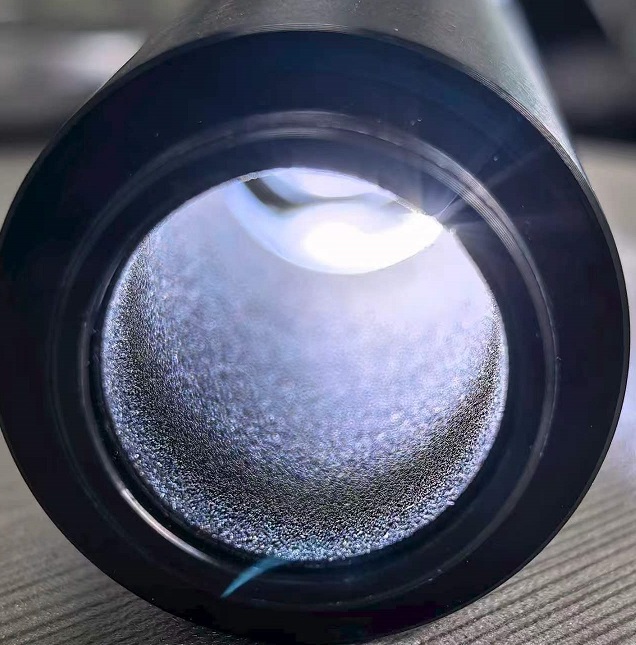
At first glance, the 0.5-percentage-point difference in absorption seems negligible. However, inside a lens barrel where stray light undergoes multiple reflections, this small gap is dramatically amplified. Tsingcarbo® Black film features an engineered microporous surface structure. When stray light enters these micropores, photons experience repeated reflections, scattering, and absorption, with virtually no chance of escape, resulting in a broadband absorption of up to 99%. Take the residual energy after two reflections as an example: a wall absorbing 99% leaves only 0.01% of the initial stray light energy, while a wall absorbing 98.5% leaves 0.0225% — 2.25 times higher. In long lens barrels or multi-element lens assemblies, this cumulative difference translates directly into a darker background and a significantly higher signal-to-noise ratio.
The dividing line in reliability is “no shedding” versus “peeling.” Tsingcarbo® Black film achieves its absorption through an intrinsic micro- and nano-structured design. It does not rely on resin-bonded fibers or particles, so it releases no fibers or dust under thermal cycling, strong vibration, or humidity changes, fully satisfying the stringent cleanliness requirements of space optics, laser instruments, and other critical applications. In contrast, traditional matte black paint relies on a resin matrix encapsulating carbon black or similar pigments to form an absorbing layer. Adhesion is susceptible to aging and differences in thermal expansion coefficients, and peeling and flaking tend to occur over time. Once paint chips or debris appear, they not only contaminate lenses but also become new scattering sources in the optical path, degrading the absorption performance over time and potentially rendering the optical system unusable.
The application process also demands considerable skill and experience. Applying film to non-flat, multi-curvature interior surfaces is highly prone to air bubbles, wrinkles, and misaligned seams — even minor defects can create anomalous reflections in the light path. Suzhou Tsingcarbo Nano Materials Co., Ltd. not only supplies Tsingcarbo® Black light-absorbing film but also provides professional film application services. Their technicians can apply the film precisely to the inner wall of a lens barrel, achieving a perfectly flat, wrinkle-free surface with tight, seamless joints, thereby fully preserving the integrity and optical consistency of the microporous light-trapping structure. In comparison, traditional black paint can be sprayed and adapts relatively well to complex shapes, but the uniformity of the coating thickness is highly dependent on the operator’s technique. Defects such as runs, sags, and orange peel are difficult to avoid entirely, and the solvent vapors released during spraying impose additional requirements on the working environment and personal protection.
In summary, while 98.5% absorption black paint still holds a place in the market due to its lower cost and ease of application, Tsingcarbo® Black light-absorbing film — with its 99% absorption, absolute freedom from particle shedding, and the precision-fit results delivered by professional application services — is becoming the advanced choice for lens barrel blackening in high-end equipment such as astronomical telescopes, star trackers, and LiDAR systems, where zero contamination, high stability, and ultimate stray light suppression are mandatory.
Name: Jimy Ji
Mobile:+86 18915768767
Tel:+86 13646226232
Whatsapp:8615370757815
Email:sale@tsingcarbo.com
Add:No. 326, Honghu Road, Economic and Technological Development Zone, Kunshan, Suzhou, Jiangsu, China