Welcome: Suzhou Tsingcarbo Nanomaterials Co., Ltd



sale@tsingcarbo.com
+86 13646226232

Home Applications Upgrading Honeycomb Anti-Glare Mesh with…
Honeycomb anti-glare mesh (also called a honeycomb louver) is widely used inside optical instruments, precision lighting, and imaging systems as a light-shaping and stray-light-control component. Its hexagonal cell structure lets the intended beam pass while trapping off-axis glare. For a high-end optical instrument manufacturer's latest product, the standard commercial honeycomb mesh could no longer meet the stricter stray-light requirement: metallic cell walls and rim edges reflected stray light back into the optical path, degrading signal-to-noise and image contrast.
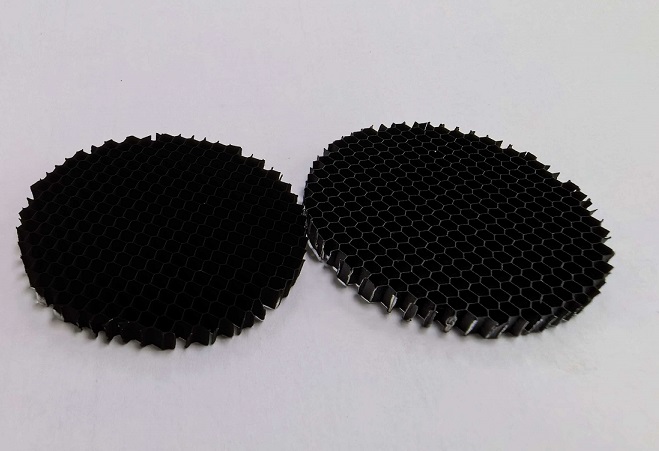
We applied our nano-porous carbon-based light-absorbing spray coating (Tsingcarbo® Black Coating) onto the customer's honeycomb mesh. The coating conforms to the fine, three-dimensional honeycomb geometry and forms a deep, uniform matte-black absorbing surface across cell walls, edges, and rim.
The honeycomb mesh is a complex 3D structure; the conventional electrophoretic blackening process cannot drive reflectance low enough on fine, densely packed cells — as seen on the right of the comparison photo, the cell walls still read gray and reflective. Our nano-porous carbon spray forms a deep, uniform matte-black layer across every wall, edge, and rim, reaching mirror reflectance as low as 0.1% at lower cost and shorter lead time than switching to a more expensive black-coating route.
The customer's high-end instrument now meets its stricter internal stray-light specification with a single, integrated, vacuum-free, cost-effective coating solution.
Name: Jimy Ji
Mobile:+86 18915768767
Tel:+86 13646226232
Whatsapp:8615370757815
Email:sale@tsingcarbo.com
Add:No. 326, Honghu Road, Economic and Technological Development Zone, Kunshan, Suzhou, Jiangsu, China