Welcome: Suzhou Tsingcarbo Nanomaterials Co., Ltd



sale@tsingcarbo.com
+86 13646226232

Home Applications Application Case: Tsingcarbo® Black Ligh…
Project Background
In astronomical observation and optical telescope systems, capturing faint light from celestial bodies puts extremely high demands on internal optical suppression. Even minor stray light reflected from mechanical structures will generate glare, ghost images and background haze, reducing image contrast and signal-to-noise ratio, which makes it difficult to identify dim deep-sky targets.
Multiple telescope developers and amateur astronomy equipment manufacturers have faced this typical optical interference problem. By adopting Tsingcarbo® Black light-absorbing film developed by Suzhou Tsingcarbo Nano Materials Co., Ltd., customers have effectively restrained internal stray-light reflection, restored real dark-field performance of optical systems, and balanced assembly convenience and long-term operational reliability.
Project Pain Points: Internal Cavity Reflection Degrades Telescope Imaging, Traditional Extinction Solutions Have Obvious Deficiencies
Telescope optical chambers include tube inner walls, lens spacers, baffles, shade hood inner surfaces and lens holder steps. When ambient stray light or off-axis light hits these mechanical surfaces, secondary reflection occurs. The reflected light overlaps on the focal plane, covering faint star signals, resulting in hazy images, obvious ghost artifacts under backlight conditions, and severely limiting observation performance.
Customers initially evaluated three conventional extinction solutions: black anodizing, matte extinction paint and flocked paper. Each shows prominent drawbacks in practical telescope applications.
· Black anodizing: Hemispherical reflectance remains above 5%. It cannot meet the requirement for ultra-low reflection for deep-sky observation. Modification requires custom machining of mechanical parts with high prototype iteration cost.
· Matte extinction paint: The spraying process is complicated, requiring masking and long curing time. Paint film is prone to peeling under large temperature cycles. Volatile outgassing substances may contaminate lenses and optical elements inside the sealed telescope cavity.
· Flocked paper: Low-cost and flexible, but flocking fibers easily shed powder and hair. Falling debris pollutes precision optical surfaces. Its absorption performance declines notably in near-infrared band, and it cannot withstand wide-range temperature variation in outdoor field observation.
All three traditional methods are either hard to adapt to complex curved and narrow cavity structures, or carry risks of contamination and performance attenuation. They cannot satisfy comprehensive requirements of astronomical telescopes for broadband extinction, cleanness and environmental stability.
Solution: Apply Tsingcarbo® Black Light-Absorbing Film Inside Telescope Optical Cavities
After sample comparison and optical testing, customers selected Tsingcarbo® Black high-performance light-absorbing film (Model TCB-F-040) for pasting on telescope inner mechanical structures. Relying on nano-porous carbon “optical-maze” light-trapping microstructure, the film captures incident light across UV-Vis-NIR bands, suppresses cavity stray-light reflection from the source, and builds a pure low-reflection environment for telescope imaging.
On-site implementation is simple without redesigning or remachining existing mechanical components. Operators can laser-cut or die-cut the film according to baffle, spacer and lens-barrel dimensions. The flexible film can be directly pasted onto curved and narrow inner surfaces. No curing period is needed after roller lamination, shortening prototype-debug and equipment-retrofit cycles.
After installation, ghost images and background fogging caused by internal reflection are greatly eliminated. Imaging contrast and dark-field performance are significantly improved. The optical system can stably detect faint celestial-body signals. Long-term environmental tests have verified stable extinction performance, and the stray-light interference problem troubling telescope optical design is well resolved.
Core Advantages of the Material: Tailored for Telescope Optical Cavity, Balancing Optical Performance, Mechanical Reliability and Operation
1. Broad-Spectrum Ultra-Low Reflection for Astronomical Observation
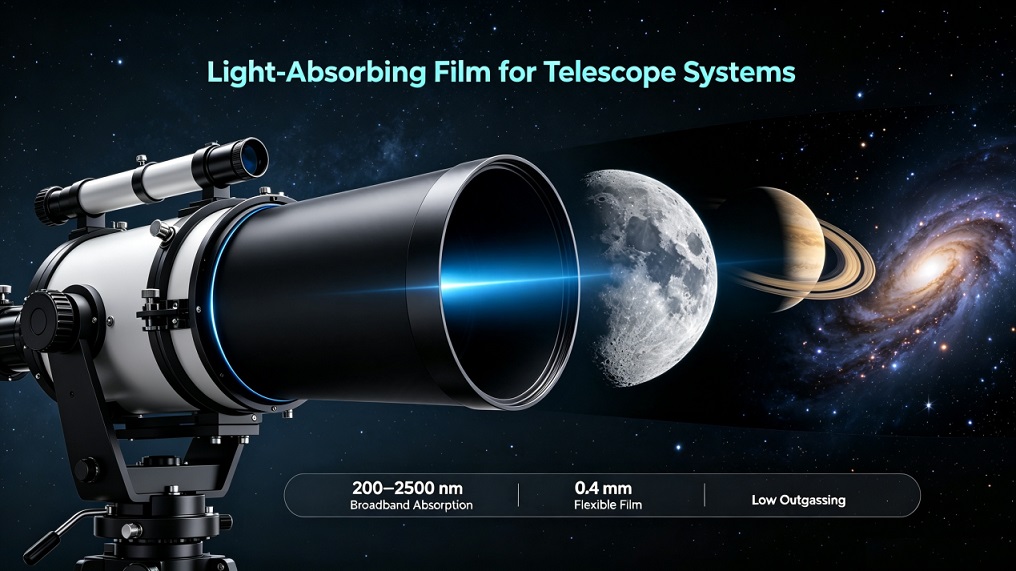
Tsingcarbo® Black light-absorbing film covers 200–2500 nm ultraviolet-visible-near-infrared working band, with typical total hemispherical reflectance of ~1%. Compared with anodized black metal and ordinary extinction paint, it delivers superior stray-light trapping capability, effectively suppressing off-axis reflection and ghost noise for both visual observation and astronomical camera imaging.
2. Ultra-thin & Flexible, Fits Complex Curved and Narrow Cavities
At only 0.4 mm thickness, the film features outstanding flexibility and fits curved surfaces with radius ≥5 mm. It can closely attach to lens-barrel inner walls, spacer side faces, baffle surfaces and shade-hood inner walls. It adapts to complex inner structures of refracting, reflecting and catadioptric telescopes without changing original mechanical drawings.
3. Non-shedding & High Wear Resistance, Guarantee Internal Optical Cleanness
With Martindale wear resistance ≥10 000 cycles, the dense continuous surface avoids powder shedding and fiber dropping risks that trouble flocked materials. Floating dust on the film surface can be removed by low-adhesion adhesive tape instead of wiping. It prevents secondary contamination to lenses and sensors inside sealed telescope chambers.
4. Low Outgassing & Excellent Temperature Stability for Field Observation
It features low-VOC and low-outgassing properties (TML <1%, CVCM <0.05%). No volatile substances will precipitate and pollute optical components. Operating temperature ranges from -40 ℃ to +120 ℃. Performance maintains stable after 100 temperature cycles, resisting aging and moisture absorption, and adapting to drastic temperature changes for outdoor astronomical field observation.
5. Consumable-oriented & Easy-to-install for Prototype and Mass Production
Self-adhesive backing enables peel-and-stick installation with no curing time required. Laser cutting and die-cutting support custom shapes for various internal optical parts. When damaged by accidental mechanical impact, old film can be peeled off and replaced on-site quickly. It suits fast iteration of R&D prototypes as well as batch production of telescope products.
Application Summary
This application case proves that Tsingcarbo® Black light-absorbing film provides a lightweight, high-performance solution for stray-light suppression inside telescope optical cavities. For internal extinction scenarios where traditional anodizing, spray paint and flocked paper show defects, this material integrates broadband ultra-low-reflectance optical performance, curved-surface conformability, clean non-shedding feature and wide-temperature stability. Its convenient past-and-replace working mode effectively compensates for the deficiencies of conventional telescope extinction processes.
Flexible nano-porous-carbon light-absorbing films will become a preferred option for R&D and upgrading of astronomical telescopes, observation binoculars, star trackers and other precision optomechanical equipment. Suzhou Tsingcarbo Nano Materials Co., Ltd. keeps deep-driving the development of nano extinction materials. We provide customized light-absorbing film solutions for machine vision, astronomical optics and precision detection industries, helping customers eliminate stray-light interference and optimize final imaging quality.
For sample request or custom solution consultation, please contact our sales team at sale@tsingcarbo.com.
Name: Jimy Ji
Mobile:+86 18915768767
Tel:+86 13646226232
Whatsapp:8615370757815
Email:sale@tsingcarbo.com
Add:No. 326, Honghu Road, Economic and Technological Development Zone, Kunshan, Suzhou, Jiangsu, China